

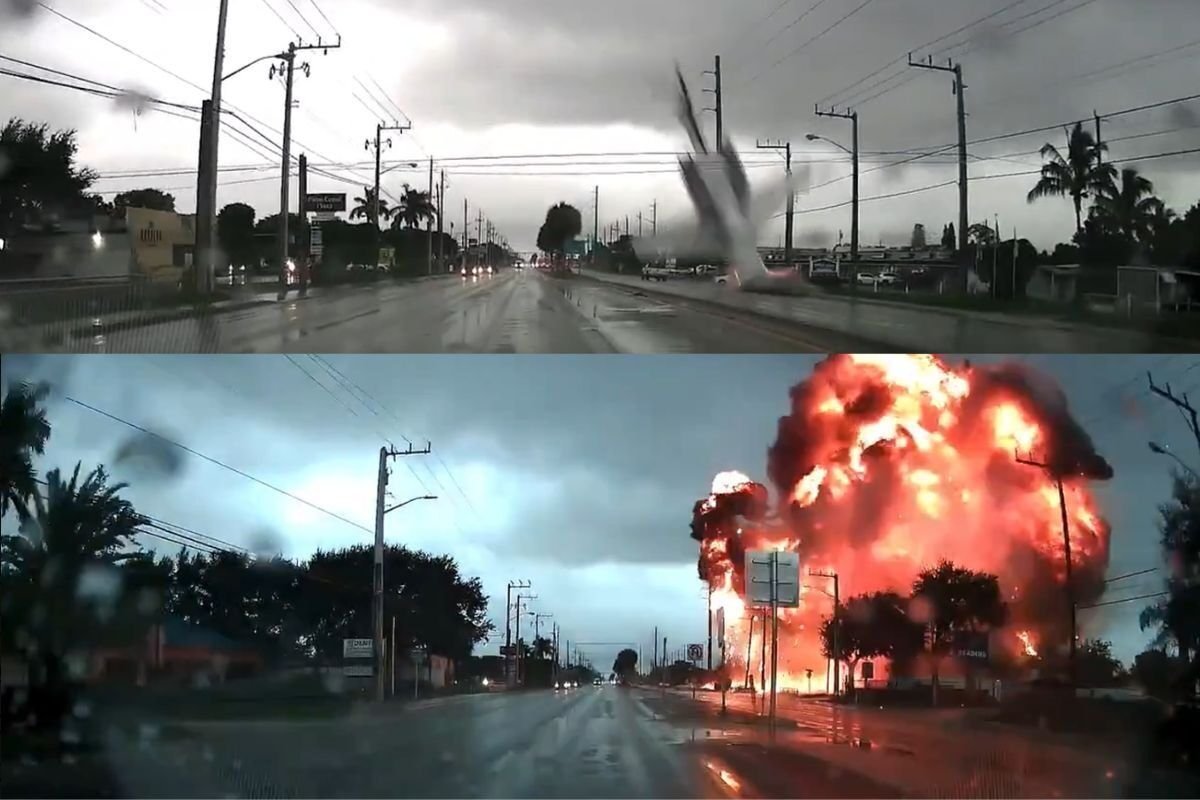
A Learjet 60 business jet may have begun breaking apart in midair before crashing into a South Florida community, killing all nine people aboard, federal investigators said Monday, November 2. The aircraft crashed around 12:50 p.m. ET on November 1 in Palm Beach County while traveling from Austin, Texas, to North Eleuthera Airport in the Bahamas. The crash occurred less than 10 miles from President Donald Trump’s Mar-a-Lago resort. Two crew members and seven passengers died, while a man on the ground suffered a leg injury. The impact triggered multiple fires, scattered debris across a wide area and forced approximately 600 people to evacuate nearby homes.
During a news conference, National Transportation Safety Board (NTSB) member Thomas Chapman confirmed that investigators had found evidence suggesting the aircraft began breaking apart before impact. However, officials have not determined what caused the crash. Investigators are also searching for the cockpit voice recorder, commonly known as a black box. Chapman said records indicated that a recorder had been installed on the aircraft at some point, although it remains unclear whether it was still aboard. “We’re very hopeful that we can recover it,” he said. He added that investigators could still reconstruct the accident through wreckage examinations, maintenance records and other evidence if the device is not recovered.
Cockpit recordings have revealed the crew’s final communications before the crash. According to audio published by LiveATC, the crew reported managing ice, encountering moderate turbulence and searching for smoother flying conditions. Less than a minute later, a person in the cockpit issued a mayday call, reporting a descent rate of 10,000 feet per minute. The rate subsequently increased to 20,000 feet per minute as the crew declared an emergency. “We’re going to crash into the ground,” the person said. The final cockpit transmission, approximately 35 seconds after the initial distress call, was: “We’re out of time.” Flight-tracking website Flightradar24 reported that the vertical descent rate exceeded 32,000 feet per minute at one point.
Severe weather and possible icing conditions are major areas of the investigation. Heavy rain and thunderstorms were moving through the region around the time of the accident, according to AccuWeather. Experts have suggested that the aircraft may have encountered an intense thunderstorm with powerful upward currents of warm, moisture-filled air. Such conditions can cause supercooled water droplets to freeze rapidly upon contact with an aircraft. MyRadar Weather senior meteorologist Matthew Cappucci explained that severe icing can affect an aircraft’s aerodynamic performance and, in extreme situations, lead to a complete loss of maneuverability. Chapman confirmed that the crew had reported managing ice and picking up precipitation before the crash.
Aviation expert Robert Joslin, a professor at Embry-Riddle Aeronautical University, said a catastrophic event may have caused the aircraft to lose control. After reviewing cockpit audio and crash footage, he identified icing, turbulence and possible structural damage as factors investigators should examine. Joslin also highlighted the reported overspeed condition, which occurs when an aircraft exceeds its maximum operating speed and can potentially damage its systems and structure. However, he stressed that the cause remains unknown. Investigators will examine maintenance records, weather conditions, aircraft components and any recovered cockpit recordings before reaching conclusions.
Among the victims was 20-year-old copilot Nathalia Filgueiras, who had dreamed of becoming a pilot since she was 12. Her sister, Giulia Filgueiras, 21, described her as a brave and remarkable young woman who remained committed to her ambitions. “She fought until the last moment she could,” Giulia said. Their mother, Camila Corteleti, said Nathalia had accumulated more than 1,300 flight hours and earned her pilot’s license at just 17. She worked for Upper Jets, a private charter company based in Fort Lauderdale. The company expressed condolences to the victims’ families and confirmed that it was cooperating with local, state and federal authorities.
NASA Administrator Jared Isaacman also praised Nathalia’s actions during the emergency in a statement on his personal X account. An experienced pilot with more than 8,000 flight hours, Isaacman highlighted that she continued communicating with air traffic control until the final moments. “She was doing her job, communicating with (air traffic control) right to the end in a terrifying situation,” he wrote. He also urged the public not to speculate about the crash, pointing to unanswered questions surrounding aircraft maintenance, possible structural failure and the impact of weather and turbulence.
Family members identified several passengers killed in the accident as Adam Robinson, 45, his wife, Helen Sharp, 40, and their children, Charlie, 4, and Emma, 2. Their nanny, Anita Maria Cetina, was also aboard, along with another couple, Rachael Reed and Charmi Fehr. The Palm Beach County Medical Examiner’s Office said it had not yet officially identified all nine victims. In a joint statement released November 2, the families thanked emergency responders, investigators and the local community for their support. They also expressed sympathy for the families of the two pilots who died in the crash.
The Federal Aviation Administration confirmed that the Learjet departed Austin-Bergstrom International Airport and was headed to North Eleuthera Airport in the Bahamas. Investigators are examining the aircraft’s maintenance history, flight records, radar information and weather conditions to establish what happened. Recovery efforts have been complicated by water accumulating inside the impact crater. NTSB investigator Timothy Monville said retrieving the major wreckage from the crater on the roadway would be one of the biggest challenges. Investigators are also examining whether the debris field supports the possibility of an in-flight breakup.
Although severe weather and icing remain major concerns, authorities have not confirmed either as the cause of the accident. The possibility of mechanical problems or structural failure also remains under investigation. The NTSB is continuing to examine the wreckage and available flight information, while attempting to recover the cockpit voice recorder. Officials have emphasized that determining the precise cause will require a detailed investigation, and no definitive conclusions have been announced.